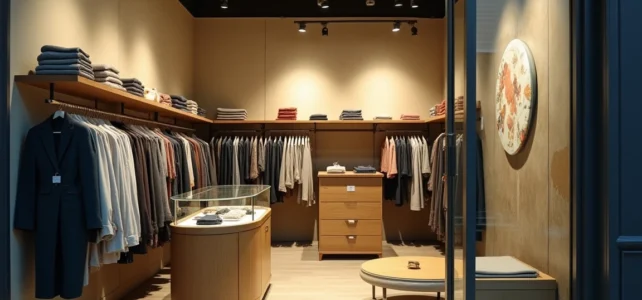
Christine Laure, a women’s ready-to-wear brand born in Gray in Haute-Saône, has gone through a lengthy judicial process lasting several months before the commercial court of Dijon made its decision. The question now is what the new scope of the network and the change of shareholder concretely mean for the brand, its employees, and its customers.
Acquisition of Christine Laure by Amoniss: what the judgment figures reveal
| Criterion | Before the acquisition | After the acquisition (Amoniss offer) |
|---|---|---|
| Branches | Complete network (branches + affiliates) | 52 branches retained |
| Affiliates | Included in the initial scope | 47 affiliates maintained |
| Employees | 284 employees | 200 of the 284 employees retained |
| Shareholder | Historical family group | Amoniss Group (also owner of Pimkie) |
The commercial court of Dijon made its decision on November 28, 2025, accepting the offer from the northern group Amoniss. Three buyers had positioned themselves. The accepted offer covers almost all points of sale but leaves aside 84 positions out of 284, nearly a third of the workforce.
The question these data raise directly concerns the business model: maintaining so many physical points of sale while reducing the payroll implies a streamlined operation per store. The transition under Amoniss is therefore not just a change of ownership; it is a change in operational logic.
To better understand the future of Christine Laure after the definitive closure of certain sites, one must look at what Amoniss has already implemented in its other brands.

Multiformat and phygital strategy: the Pimkie model applied to Christine Laure
Amoniss is not new to struggling ready-to-wear. The group acquired Pimkie and deployed a strategy that the specialized press describes as “multiformat”: smaller sales areas, more corners and shop-in-shops, a targeted presence in high-performing shopping malls rather than a broad territorial network.
This approach is presented as transposable to Christine Laure. Specifically, this means that some iconic downtown stores will close, but the brand will not completely withdraw from physical locations. It is changing format.
What the multiformat model changes for customers
- The retained stores become more “service and CRM” oriented: customer database, personalized follow-ups, in-store events, rather than a simple passive point of sale
- The corners in shopping malls allow for shared costs of rent and staff, which explains the reduction in workforce despite maintaining the number of points of sale
- Click and collect, e-reservation, and in-store returns, already deployed at Pimkie, are explicitly presented as the next step for Christine Laure
The phygital shift is not an empty term in this context. Amoniss has reported a significant increase in the share of online sales in its brands since 2024. Christine Laure must become a platform combining direct sales, marketplace, and multi-brand network, not a network relying solely on owned stores.
Christine Laure network in shopping malls: selective closures, not massive withdrawal
The confusion between “closure of iconic stores” and “disappearance of the brand” is common in comments on social media. The judgment data tell a different story.
52 branches and 47 affiliates retained represent a dense network for a brand of this size. However, the points of sale that are disappearing are those whose revenue/rent ratio no longer holds, particularly in city centers where commercial leases have significantly increased in recent years.
The Amoniss logic is to concentrate resources on profitable locations. High-traffic shopping malls are prioritized. Isolated downtown stores, with high rents and declining foot traffic, are the first to be sacrificed.
Employment and retraining of non-retained employees
The 84 unretained positions represent the painful point of this operation. The recovery and subsequent transfer procedure includes an employment protection plan for the affected employees. General Director Élodie Chellé, interviewed by France 3 Bourgogne, described the acquisition as “very good news,” but the fate of the eliminated positions remains a blind spot in official communication.
Women’s ready-to-wear in France: Christine Laure facing the sector crisis
The situation of Christine Laure is not isolated. French ready-to-wear is undergoing a profound restructuring period, accelerated by the Covid crisis and then by rising operating costs. Several historical brands have been placed in recovery or liquidation in recent years.
What distinguishes the Christine Laure case is the speed of the procedure and the fact that a buyer has retained most of the network. In many comparable cases, the acquisition only concerns the brand and stock, without the stores.
- Amoniss is acquiring the commercial premises (leases) in addition to the brand, which gives Christine Laure a physical base to restart
- The group already has a logistical and digital infrastructure through Pimkie, which reduces the deployment time of omnichannel tools
- The historical clientele of Christine Laure, mostly composed of women over 45, is not the same as that of Pimkie, which limits cannibalization between the two brands
The main risk remains the loss of identity. When a group manages several brands with the same tools, the same suppliers, and the same fast turnover logic, product differentiation can erode. Amoniss’s ability to preserve Christine Laure’s positioning on a classic and quality wardrobe will be the true test of the upcoming seasons.
The brand enters a phase where its legal survival is secured, but its commercial relevance remains to be proven. The coming months will reveal whether the platform model works for a clientele accustomed to entering a dedicated store.